
Paint correction is often necessary for brand-new cars because factory assembly lines, open-air transport, and improper dealership washing techniques often leave surface defects such as swirl marks and iron contamination. Undergoing professional correction ensures the clear coat is perfectly leveled and chemically pure, which is essential for the proper bonding and long-term durability of ceramic coatings or paint protection films. Without this step, you are effectively sealing factory defects under your protective layer.
The “New Car” Paradox: Why Showroom Shine is Deceptive
When you take delivery of a new vehicle, the excitement often masks the microscopic reality of the paintwork. It is a common assumption among Connecticut owners that a car fresh from the factory is in “perfect” condition. In reality, the journey from the assembly line to your driveway is fraught with opportunities for surface damage.
Vehicles often sit in holding lots or travel via rail, exposing the hot, clear coat to “rail dust”, tiny, metallic iron particles that embed themselves into the finish. Furthermore, dealership “prep” teams are often high-volume departments that use aggressive brushes or contaminated towels to quickly wash cars for the lot. This results in the “spiderweb” swirls that distract from the paint’s natural depth. Our initial assessments almost always reveal that car paint correction in Connecticut is required to reach a true, concours-level finish.
Comparing Factory Condition vs. Post-Correction Standards
Understanding the difference between a “delivered” finish and a “corrected” finish is vital for any owner who demands technical excellence.
| Feature | Factory “New” Condition | Post-Correction Condition |
| Surface Clarity | Often “cloudy” due to micro-abrasions | Absolute mirror-like depth and reflection |
| Contamination | High (Iron fallout and transport film) | Zero (Chemically and mechanically sterile) |
| Defect Level | Factory sanding marks and swirls | 95-99% defect-free substrate |
| Coating Readiness | Poor (Bonding is obstructed by oils) | Optimal (Maximum covalent bonding) |
3 Reasons to Correct Your Paint Before Adding Protection
1. Locking in Perfection
Applying a ceramic coating or PPF is a semi-permanent decision. If you apply these products over factory swirls or sanding haze, you are “locking” those imperfections under a protective shield for years. Professional Connecticut paint correction removes the defects first, ensuring that what you are protecting is actually worth seeing.
2. Maximizing Gloss and Refractive Depth
Gloss is a byproduct of how light reflects off a surface. A factory finish with micro-swirls scatters light in multiple directions, leading to a duller appearance. By leveling the clear coat to a perfectly flat plane, we allow light to bounce back directly at the eye. During a recent project for a client in West Hartford, the increase in gloss meter readings after correction on a brand-new black finish was staggering.
3. Ensuring Long-Term Film Adhesion
For those investing in Paint Protection Film (PPF), the surface must be flawlessly smooth. Any remaining iron contamination or wax residue can cause the film to lift at the edges or create tiny “silvering” bubbles. A thorough car paint correction ensures the film lies perfectly flat against the clear coat for a virtually invisible install.
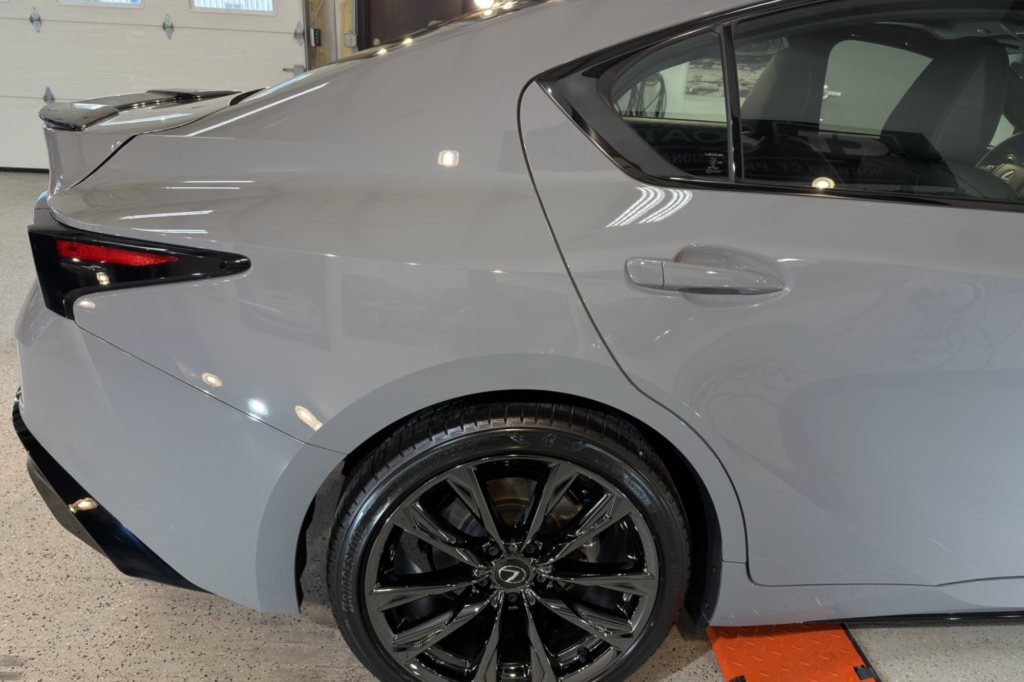
Applying our New Car Preservation Standard
We address the unique challenges of factory-delivered vehicles through our proprietary New Car Preservation Standard. This isn’t a standard detail; it is a high-end engineering process built on an Obsession for Excellence and over nine years of expertise.
To solve the issues that dealerships overlook, we utilize our luxury-grade facility:
- 136 Spotlights for Perfect Detailing Visibility: Standard shop lighting is insufficient for new car prep. Our high-intensity array reveals factory sanding marks and “buffer trails” that are invisible to the naked eye.
- Climate-Controlled Shop: Modern clear coats are sensitive to temperature. We perform our correction in a stabilized environment to ensure compounds work effectively without marring the soft, clear coat.
- Epoxy Floor for a Clean, Reflective Workspace: This prevents concrete dust from entering the polishing pads, ensuring consistent quality throughout the process.
- Precision Equipment: We use digital paint depth gauges to measure exactly how much clear coat we have to work with, removing only the bare minimum required to achieve a flawless finish.
The Myth of the “Dealership Detail”
A common industry misconception is that the “protection package” offered by the dealership includes a professional correction. In reality, dealership “detailers” are often under immense time pressure. They typically apply “glazes”, heavy oils that temporarily fill in scratches to make the car look good for delivery. Within three washes, these fillers disappear, revealing the original damage. True Connecticut paint correction services involve the mechanical removal of defects, providing a permanent fix rather than a temporary mask.
Experience the CT Ceramic Coatings Difference
At CT Ceramic Coatings, we believe in delivering uncompromising quality for every vehicle. Our professional, precision-driven approach is designed for owners who know that “new” is just the starting point. With our coatings, you can feel complete confidence every time you see your vehicle’s true potential.
By choosing us for your paint correction in Connecticut, you are making the best investment for enhancing your vehicle’s value. We invite you to visit our facility and see our 136 spotlights in action.
Ready to achieve a truly flawless finish? Contact us or Schedule Your New Car Consultation Today
People Also Ask (FAQ)
- Does paint correction remove clear coat?
Yes, but only a microscopic amount. When using precision equipment, we typically remove less than 0.1 mils of clear coat, roughly the thickness of a Post-it note, leaving your factory protection intact.
- Can I skip the correction if I don’t see any scratches?
Even if you can’t see them, “rail dust” and chemical fallout are almost certainly present. A mechanical decontamination and light polish are required to ensure your ceramic coating bonds properly.
- Is a correction needed for white or silver cars?
While light colors hide swirls better, they are highly susceptible to “orange spots” (rusting iron particles). Professional Connecticut paint correction is the only way to ensure these are fully removed from the paint’s pores.