
Deciding between paint correction and full repainting depends entirely on how deep your vehicle’s paint damage goes. Paint correction is a non-invasive process that removes shallow surface defects like swirl marks, light scratches, and oxidation, while preserving your original factory finish. However, if the damage has penetrated through to the primer or bare metal, or if you are dealing with extensive peeling and clear coat failure, a full repaint is necessary to restore the panels.
For luxury, performance, and collectible vehicle owners, protecting a premium exterior finish from daily road wear is a constant priority. When defects occur, choosing the right restoration pathway requires an accurate assessment of your paint’s layers. Choosing paint correction whenever possible allows you to retain your car’s highly valued factory-original paint, maximizing its long-term resale value and aesthetic depth without the time and expense of an aftermarket body shop respray.
Understanding the Anatomy of Automotive Paint
To choose the safest restoration method, it is crucial to understand the distinct cross-sectional layers that make up a modern factory paint system.
- The Primer: Applied directly to raw aluminum, steel, or composite body panels, this foundational layer prevents corrosion and establishes an even, high-bond surface for subsequent coatings.
- The Base Coat: This specialized layer contains the visual automotive pigments, metallic flakes, or pearlescent additives that dictate your car’s exact color. It is thin, fragile, and inherently dull without a top seal.
- The Clear Coat: This thick, transparent top barrier seals the base coat to generate a high-gloss finish. It contains essential UV inhibitors that block solar degradation and acts as the sacrificial layer against physical road debris and chemical wash marring.
Paint Correction vs. Full Repainting: A Quick Comparison
Identifying the precise depth of a surface defect dictates whether a technician can mechanically level the clear coat or if they must strip the panel down to the raw substrate. The table below breaks down how these two approaches differ across crucial technical and economic parameters.
| Comparison Factor | Paint Correction | Full Repainting |
| Primary Process | Micro-level abrasive leveling of the factory clear coat layer | Complete removal of degraded paint, followed by full primer, base, and top-coat reapplication |
| Defects Treated | Wash swirls, micro-scratches, water spots, buffer trails, light oxidation | Clear coat delamination, rock chips exposing metal, deep key scratches, rust |
| Value Preservation | High; retains the original assembly-line factory paint, which collectors prioritize | Variable; poorly executed aftermarket paint significantly decreases luxury resale value |
| Average Turnaround | 1 to 3 days within an optimized detailing facility | 1 to 3+ weeks due to disassembly, curing, and multi-stage re-spraying |
| Technical Limit | Dictated by the remaining micron thickness of your factory clear coat | Dictated by structural panel straightness and surface preparation quality |
How to Test and Diagnose Your Car’s Paint Damage
Determining which cosmetic pathway matches your vehicle’s actual condition requires systematic surface testing. Professional technicians rely on specific visual and physical tests to confirm if paint can be saved without spraying new material.
1.Perform the Fingernail Test:
Lightly slide your fingernail across the clean scratch at a 90-degree angle. If your nail catches in the groove, the clear coat has been fully penetrated. This cannot be buffed out and requires a localized touch-up or repainting.
2.Inspect for Clear Coat Delamination:
Check horizontal surfaces under direct light for patchy, opaque white spots or flaking. This indicates complete clear coat failure, which requires a full panel repaint.
3.Conduct a Focused Reflection Check:
Examine the paint under direct sunlight or an LED inspection lamp. If you see fine, spiderweb-like lines radiating from the light’s focal point, the car has superficial wash marring that can be fully fixed with paint correction.
4.Execute a Digital Paint Gauge Audit:.
Use an electronic paint depth gauge to measure the total thickness in microns. This confirms if there is enough healthy clear coat available to safely polish without burning through to the color coat.
The CT Ceramic Coatings Difference: Elevating Vehicle Protection
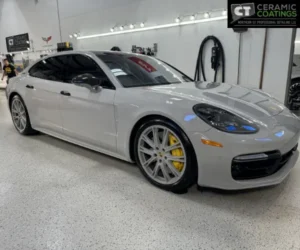
At CT Ceramic Coatings, preserving a high-end vehicle requires specialized care that goes far beyond standard detailing. Backed by nine years of expertise in paint restoration and surface chemistry, we specialize in complex paint types across exotic, luxury, and high-performance vehicles. Our unmatched services cater directly to discerning owners who demand absolute perfection.
Every vehicle undergoes an intensive multi-stage decontamination protocol inside our elite, climate-controlled shop. Engineered with full air conditioning, cleanroom air filtration, and professional epoxy floors to eliminate airborne dust, our workspace features a grid layout of 136 high-intensity spotlights that allows our technicians to examine surfaces with zero distortion.
We utilize digital precision equipment to map out paint thickness variations across body panels. Combining these diagnostics with advanced technology allows us to correct deeper paint defects safely, removing the risk of burning or thinning your factory clear coat. This commitment to detailed craftsmanship yields a mirror-like finish with absolute clarity.
Restoring the paint is only the initial phase; maximizing its longevity is where we excel. Immediately following refinement, we install unparalleled protection systems to isolate the pristine surface. By integrating premium XPEL ceramic coatings and paint protection films, we deliver enduring durability and exceptional protective qualities that guard your vehicle against chemical etching, environmental fallout, and road pollution for years to come.
Bringing Luxury-Grade Craftsmanship to the Region
Vehicles driven across the Northeast face harsh environmental stressors, from corrosive winter road salt to intense summer heat, leaving paint vulnerable to rapid oxidation and micro-abrasive erosion. Protecting your automotive investment under these cyclical conditions requires specialized regional expertise.
During a recent vehicle audit for a client seeking elite paint correction in Connecticut, we evaluated a high-performance sports car marred by deep automated wash scratches and heavy environmental etching. While the owner feared a costly, invasive body shop respray was the only option, our digital thickness gauge confirmed the factory clear coat could safely handle mechanical leveling.
Through our meticulous Connecticut paint correction protocols, we safely removed the sub-surface defects and fully restored the clear coat’s liquid-like depth. To ensure this flawless finish stands up to brutal New England winters, we sealed the panels with an advanced ceramic layer.
Providing premium paint correction services in Connecticut allows us to save owners substantial capital while preserving their vehicle’s coveted factory-original finish. Whether you are protecting a weekend collectible in Granby or a daily commuter, your vehicle deserves a high-end level of preservation that effortlessly withstands the elements..
People Also Ask
Can paint correction fix deep key scratches or rock chips?
No, paint correction cannot remove deep key scratches or rock chips that penetrate into the color coat or primer. Paint correction works by leveling the microscopic top layer of the surrounding clear coat. Defects where material is physically missing require targeted touch-up paint filling, wet sanding, or panel repainting.
How many times can a car undergo paint correction?
Typically 2 to 3 times for heavy compounding over a vehicle’s lifespan. Modern factory clear coats are thin (35 to 50 microns), and a heavy multi-stage correction removes roughly 2 to 5 microns. Light enhancement polishes, however, can be performed many more times safely since they remove minimal material.
Is it better to correct paint or repaint before selling a luxury vehicle?
Paint correction is almost always superior to repainting before a sale. Discerning buyers and appraisers use digital depth gauges to check for non-factory paint layers, which can suggest undisclosed accident damage. Correction removes surface wear while proving the vehicle retains its highly valued factory-original finish.
How long does a professional paint correction service last?
The removal of defects is permanent, but new scratches and swirls can develop if the paint is left unprotected or washed improperly. To maximize longevity, you should immediately seal the corrected surface with a professional ceramic coating or paint protection film and follow scratch-free hand-washing methods.
Request Your Specialized Paint Consultation
Do not let micro-scratches and severe environmental weathering degrade the appearance and financial value of your automobile. Discover how our precision-engineered paint restoration processes can restore your vehicle’s finish back to an elite showroom standard. Experience the technical precision and uncompromising quality that distinguishes our work.
Contact us today to request a personalized quotation, Let our team deliver the superior protection and confidence your vehicle deserves.