
Ceramic coating makes a vehicle easier to clean after rain and road grime by forming a hydrophobic, chemically resistant layer over the paint that lowers surface energy. This hydrophobic property forces water to bead up and roll off, carrying embedded dust, road salts, and dirt away before they can bond to the clear coat. As a result, road grime cannot adhere firmly to the slick surface, turning labor-intensive wash routines into effortless rinse-downs.
The Chemistry of Clean: How Ceramic Coatings Repel Water and Dirt
Factory clear coats look smooth, but under magnification, they are porous and filled with microscopic valleys. Rainwater deposits minerals, pollutants, and dirt directly into these pores, creating stubborn water spots and road grime as it evaporates.
A professional ceramic coating uses silicon dioxide or nano-ceramic compounds to seal these microscopic pores. This creates a flat, non-porous layer that prevents contaminants from embedding in the paint.
The Power of High Contact Angles
The primary force behind a ceramic coating’s cleaning efficiency is its hydrophobicity or water repelling capability.
- Untreated Paint: Water typically exhibits a low contact angle, causing it to sheet out, flatline, and cling to the surface.
- Waxed Paint: Traditional carnauba waxes increase the contact angle to roughly, offering brief water-beading properties that degrade quickly under heat and UV exposure.
- Professional Ceramic Coating: Advanced nano-coatings elevate the water contact angle to $110^\circ$ or higher.
When a surface achieves a high contact angle, water can no longer flatten out. Instead, surface tension forces the water to pull itself into tight spherical beads. Because these spherical droplets have minimal surface contact with the coated paint, gravity or momentum easily sets them into motion.
Why Rain and Road Grime Struggle to Stick
Road grime is a complex mixture of oily traffic film, asphalt particles, brake dust, pulverized rubber, and organic matter. On an unprotected car, atmospheric heat and friction cause these oils and sticky residues to bond directly to the paint.
| Feature | Untreated Paint | Professional Ceramic Coating |
| Water Behavior | Sheets out and clings | Beads tightly |
| Grime Adhesion | High; bonds to clear coat pores | Low; sits loosely on top layer |
| Wash Requirement | Scrubbing & harsh degreasers | Touchless rinse & mild neutral soap |
| Chemical Resistance | Low (pH 5–9) | Exceptional (pH 2–12) |
| Self-Cleaning Effect | None | High (water carries away dirt) |
The Self-Cleaning Effect Explained
When driving through a rainstorm, an untreated car usually arrives at its destination covered in muddy streaks and dirty water marks. On a ceramic-coated car, the opposite occurs due to the self-cleaning effect.
As rain strikes the vehicle while driving, the high contact angle allows the wind to push water beads smoothly off the panels. As these beads roll across the sleek surface, they pick up loose dust, surface dirt, and fresh road spray, pulling them off the vehicle. While rain is not a substitute for a standard wash, a car with ceramic coating in Hartford County, CT will remain noticeably cleaner after driving through foul weather than an uncoated car under identical conditions.
Chemical Inertness and Environmental Shielding
Industrial rain, acid, and winter de-icers react with a bare clear coat, accelerating oxidation and trapping grime. Ceramic coatings provide robust chemical resistance (pH 2- 12). Road salts, tree sap, bug splatter, and acid rain sit loosely on the surface instead of etching the paint, making them easy to rinse away without harsh scrubbing.
Re-Engineering Maintenance: The Wash Process Transformed
The true value of a ceramic coating reveals itself during routine washing. Maintaining an uncoated vehicle often requires heavy degreasers, clay bars, and vigorous agitation with a wash mitt step that increases the risk of installing swirl marks and fine scratches in your clear coat.
Standard Maintenance Workflow for Coated Vehicles:
- High-Pressure Rinse –> Knocks off 80-90% of loose grime and salt
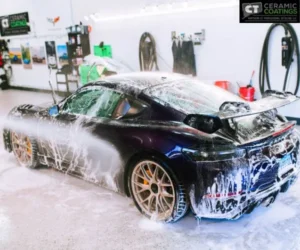
- Touchless Foam Bath –> Encapsulates remaining traffic film
- Gentle Contact Wash –> Glides effortlessly across ultra-slick panels
- Air Dryer / Blower –> Blows water out of cracks without towels touching paint
With a professionally applied coating, the wash routine becomes faster and safer:
- Effortless Pre-Rinse: A high-pressure water rinse knocks off up to 80–90% of accumulated road grime without touching the vehicle with a mitt.
- Slicker Contact Washing: During a contact wash, the wash mitt glides smoothly over the hydrophobic barrier. Dirt slides off the panels effortlessly rather than sticking, drastically reducing wash lines and swirl marks.
- Touchless Drying: Drying a vehicle is often where swirl marks are introduced. Because water cannot cling to a ceramic-coated surface, a leaf blower or dedicated car dryer easily blows water out of door jambs, emblems, and body lines. The remaining water beads slide off, minimizing the need for physical drying towels.
Craftsmanship and Protection: The CT Ceramic Coatings Difference
Achieving maximum hydrophobicity and durability requires thorough prep work and environmental control, not just applying products.
At CT Ceramic Coatings, our nine years of expertise focus on meticulous decontamination and multi-stage paint correction first. Eliminating swirl marks and defects ensures the coating creates an optimal, long-lasting bond with a factory clear coat.
Our State-of-the-Art Environment
Applying ceramic coatings requires absolute environmental control. Humidity, ambient temperature, airborne dust, and lighting precision directly influence how a liquid polymer cross-links with the clear coat during curing.
CT Ceramic Coatings Facility Standards:
- Climate-controlled clean room environment
- Advanced air filtration to eliminate dust & contaminants
- 136 high-intensity spotlights for 360° inspection
- Precision equipment for flawless leveling and curing
Our facility features a specialized, climate-controlled shop engineered to maintain strict temperature and humidity ranges, preventing high spots, rapid evaporation, or curing failure during installation:
- 136 Specialized Inspection Lights: Our bay uses 136 high-intensity spotlights to illuminate every curve and panel angle, ensuring zero high spots or residual hazing remain unpolished.
- Precision Equipment & Advanced Technology: Temperature-regulated curing systems and infrared panels guarantee that our chemical matrices level flat and cure to maximum hardness. Utilizing precision equipment and advanced technology allows us to lock in deeper optical clarity and long-term gloss.
- Certified Excellence: As an authorized installer of XPEL products, our shop pairs certified technical protocols with unmatched services to provide unparalleled protection.
Each project showcases our detailed craftsmanship, delivering durability and exceptional protective qualities designed to withstand New England’s harsher seasonal cycles.
Local Conditions: Protecting Vehicles in Hartford County
Local weather subjects paintwork to constant stress, from scorching summer sun to freezing winter roads.
During a recent vehicle audit in Windsor Locks, an untreated luxury SUV suffered dull, gritty salt etching from months of road brine. By contrast, vehicles protected with a ceramic coating in Hartford County let winter slush and de-icers wash off effortlessly with a basic pressure washer.
Driving along local roadways exposes paintwork to distinct seasonal hazards:
- Winter Road Brine & Rock Salt: Chemical de-icers used throughout the region accelerate corrosion and bite into unprotected clear coats.
- Spring Tree Pollen & Sap: Heavy pollen seasons coat vehicles in sticky, acidic residues that bake onto panels under direct sunlight.
- Summer UV Rays & Environmental Fallout: Intense solar radiation breaks down standard waxes and causes clear coat oxidation over time.
Choosing a premium Hartford County ceramic coating ensures your car stays shielded against these regional elements while cutting routine washing time in half.
Frequently Asked Questions
Can I drive my car in the rain immediately after getting a ceramic coating?
No. The coating needs 24 to 48 hours to cure initially and 7 to 14 days for full chemical hardening. Exposure to rain or water during this window can weaken or spot the finish.
Does ceramic coating mean I never have to wash my car again?
No. It repels loose dirt and creates a self-cleaning effect, but traffic film still builds up over time. Routine washes are still necessary, just much faster and easier.
Will rain leave water spots on a ceramic-coated car?
It can if rain evaporates under direct sun. However, because minerals sit on top of the slick coating rather than bonding to paint pores, spots wipe off effortlessly during your next wash.
How does ceramic coating compare to traditional wax for rain protection?
Waxes form a soft, temporary barrier that wears off in weeks. Ceramic coatings chemically bond to clear coat, providing years of durable hydrophobicity, UV shielding, and chemical resistance.
Experience the CT Ceramic Coatings Difference
Maintaining an immaculate, show-floor shine shouldn’t mean spending your weekends scrubbing away road grime, tar, and rain spots. With elite ceramic protection engineered for supreme hydrophobicity and durability, your vehicle can maintain its depth, clarity, and gloss with minimal maintenance effort.
At CT Ceramic Coatings, we combine deep technical expertise with luxury-grade facility standards to give your car the high-performance shielding it deserves.
Ready to transform your vehicle’s protection and streamline your wash routine?
Contact our expert team to schedule a consultation at our state-of-the-art facility!